What a sensory room is, and what it is not
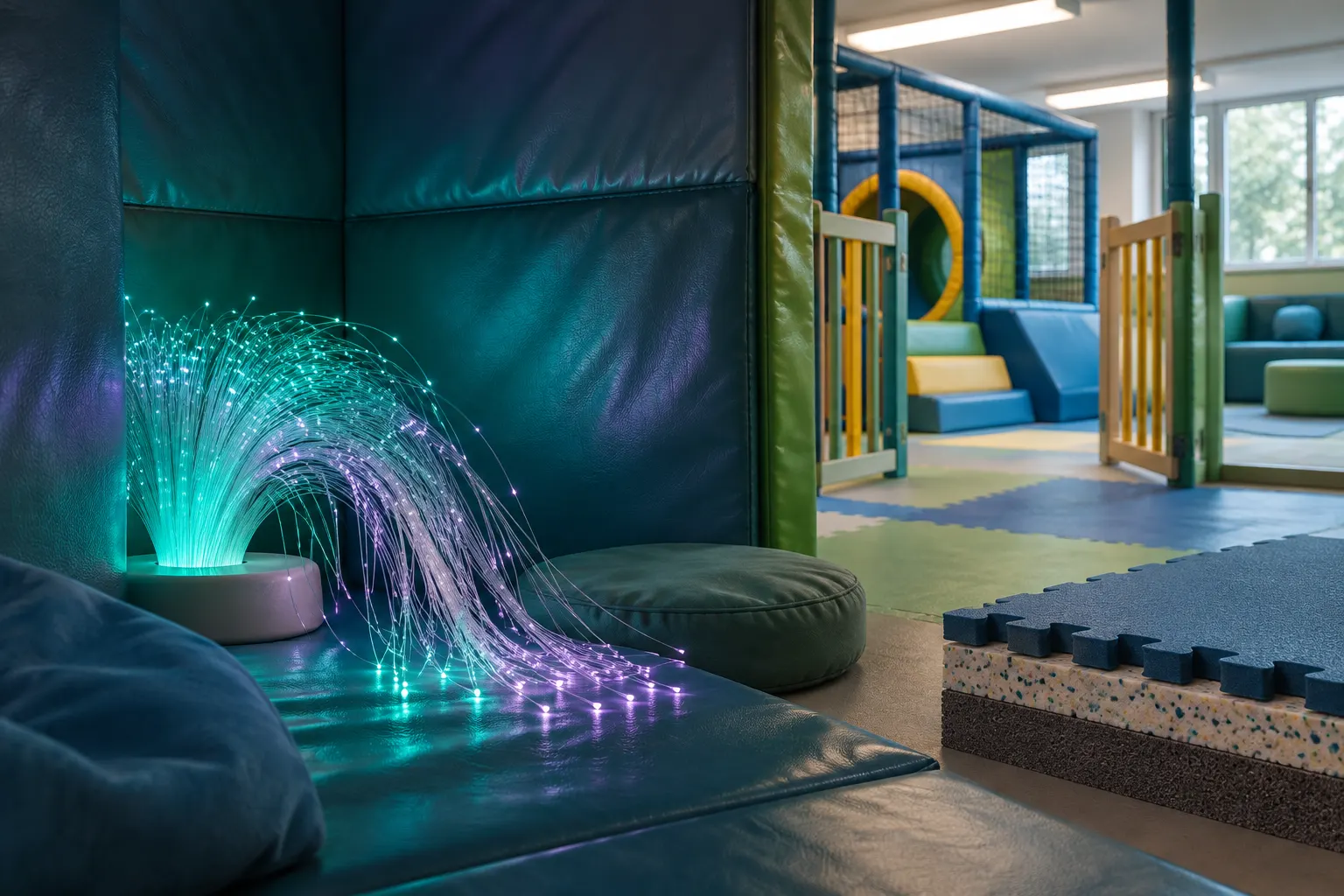
A sensory room is a distinct space with controllable sensory features, used in a way that lets a child reduce, choose or manage input from their surroundings. It may contain low-level lighting, tactile items, seating, visual features or sound controls, but its defining feature is not the equipment. It is the ability to adjust the environment and use it purposefully.
The label alone does not establish what a room can do. There is no single UK-wide standard, statutory certification or universal accreditation that makes a room a sensory room. A coloured projector, a bubble tube or music player does not by itself show that a space is suitable for regulation. Equally, a plain room can be useful if it is calm, available when needed and run in a predictable way.
A sensory room is not an intervention or a clinical assessment. No venue can properly promise that it will prevent distress, change behaviour, meet every sensory need or produce a particular outcome for a child. Parents should be cautious about claims that turn a room into a treatment. Questions about a child's individual needs belong with the child's usual health, education or care professionals, using the appropriate local statutory route where relevant.
For England, the Department for Education's SEND code of practice: 0 to 25 years is the statutory framework for identifying and meeting special educational needs and disabilities in education and related services. It does not prescribe a room design for leisure venues. It is useful context for understanding that needs are individual, should be considered with families and should not be assumed from a label.
Separate the room from the corner, the play area and the session
Parents often hear four different offers described with similar language. They are not interchangeable. A sensory corner is usually a small part of a larger room, perhaps with cushions, books or tactile resources. It can offer a pause, but it remains affected by the noise, movement and visual activity around it. Ask whether it is separated from active play, whether anyone can pass through it and whether it can be used when the main area is busy.
A quiet space may have few or no sensory resources. Its purpose is chiefly to reduce demand and provide somewhere to wait, regroup or leave a noisy environment. That can be valuable. It should not be described as a sensory room merely because it is quiet.
A soft play area with lights, projections or music is still principally a play space unless input can be reliably moderated and the child can use the area without the ordinary demands of active play. Extra lights may increase stimulation rather than reduce it. Ask whether features can be dimmed, muted or switched off, not only whether they can be switched on.
A sensory-friendly session or quiet hour is a scheduling arrangement, not a room. It may involve lower music, reduced capacity, altered lighting or clearer routines across a whole venue. That may be more useful than a separate room for some families. It does not mean that a sensory room will be open, staffed or appropriate during that session. Confirm both parts separately.
| What is being offered? | What to establish before booking |
|---|---|
| Sensory room | Whether it is separate, adjustable, available, supervised and maintained. |
| Sensory corner | Whether it is protected from the main room's noise, traffic and crowding. |
| Quiet space | Whether a child may use it when needed and how privacy and safety are managed. |
| Lit play area | Whether it remains active play and whether lights and sound can be reduced. |
| Quiet session | What changes at that time, and whether capacity, music, lighting and routines actually differ. |
Regulation and stimulation are different design jobs
A room intended to support regulation should give a child and accompanying adult a realistic way to reduce intensity. That can mean lower lighting, less sound, fewer people, a clear place to sit and an uncomplicated route back out. It may also include optional items that a child can approach or leave. The important question is whether the adult can alter the setting when it is too much.
A room designed for stimulation has a different purpose. It may invite movement, bright visual effects, music, tactile exploration and novelty. None of those features is inherently wrong, but they can make a space unsuitable at a particular moment for a child seeking less input. A venue should be able to explain which purpose its room serves, rather than assuming that all sensory equipment has the same effect for all children.
This distinction matters because a family may book expecting a retreat from a demanding environment and find an additional source of demand. Before arrival, ask: "Can the lights be dimmed?", "Can sound be reduced or stopped?", "Is there a time when the room is less busy?", and "Can we leave and return if it is not working for our child?" The answers should describe actual controls and arrangements, not general reassurance.
Do not ask staff to predict how a child will respond. They cannot make that judgement safely from a brief description. Instead, give only the practical information needed for a visit, such as whether a low-noise option, a short first visit, a clear exit route or space for an accompanying adult would help. A useful venue response identifies what it can arrange and where its limits are.
The five questions to ask at the door or on the phone
Use these questions as a short decision rule. They test whether a claimed sensory room is a managed provision rather than an attractive label. A staff member need not be a clinician to answer them, but should know who is responsible for the space and what the local procedure is.
- Who designed, selected or assessed the room and against what written rationale? There may be no external standard. A clear answer can still explain the intended use, any advice sought, and how the layout is reviewed.
- Which lights and sounds can be turned down as well as up? Ask who controls them and whether adjustments are available during your visit.
- Is entry timed or capacity limited? A separate room can become difficult to use if several families enter at once. Establish whether access is booked, first come first served or controlled by staff.
- What training do staff have for this space? Ask for the name of the training or induction, what it covers and whether staff know the escalation procedure. Do not infer specialist qualification from a general statement that staff are trained.
- What is the exit and de-escalation arrangement? Ask how you leave promptly, where an accompanying adult can go, and what staff will do if assistance is requested.
Write down unclear answers before paying a non-refundable deposit. A venue may have sensible limitations, such as no exclusive use or no guarantee of immediate entry. What matters is that those limitations are stated before the family relies on the facility.
Staffed and unstaffed provision: what changes
"Staffed" can mean several different things. It may mean a worker is present in the room. It may mean a worker is nearby and can be called. It may simply mean the wider venue is staffed. Ask which one applies. Also ask whether an accompanying adult must remain with the child. In most leisure settings, a sensory room is not a substitute for parental or carer supervision.
An unstaffed room is not necessarily unsuitable. It may be practical for a family who wants privacy and can use it independently. But the arrangement needs basic safeguards: a clear route out, a known method of calling for help, rules on who may enter, and equipment that does not create avoidable entrapment, trip or hygiene problems. A locked door or an isolated location needs particular explanation. A child should not be left without an appropriate supervising adult merely because the room feels calmer than the main play area.
The Equality Act 2010 requires service providers to make reasonable adjustments for disabled people. That duty is anticipatory, meaning providers should think in advance about barriers that disabled people may face. It does not require a venue to provide any particular sensory room, guarantee that every adjustment is possible, or accept an unsafe arrangement. It does mean "we do not do that" is not a complete answer where a reasonable change to policy, practice or physical features may be relevant.
If a provider cares for children rather than simply admitting families to a leisure activity, different legal duties may arise. In England, Ofsted registers and inspects particular childcare and early-years provision, not all rooms described as sensory spaces. Ask whether the service is registered childcare, and do not assume Ofsted registration from the presence of staff or a children's room.
Cleanliness, maintenance and access are part of the test
Sensory equipment is often handled closely, so cleaning is not a decorative detail. Ask how soft items, tactile objects and shared equipment are cleaned, what happens if an item cannot be cleaned effectively, and whether there is a way to report a soiled or damaged feature. The answer need not be technical. It should identify a routine, responsibility and a route for taking equipment out of use.
Look for practical signs of maintenance: secure fittings, intact covers, no exposed wiring, no loose fragments, stable seating and equipment that works as staff describe. A feature that cannot be controlled is not adjustable. A room with broken items may still be safe after they have been isolated, but parents should not be asked to treat disrepair as part of the experience.
Access includes more than the doorway. Check whether a wheelchair, buggy or accompanying adult can enter without blocking the exit, whether the route is free from sudden steps or clutter, and whether staff can explain the fire or emergency exit arrangement. Ask if a child can leave the room quickly without passing through the busiest part of the venue. These are practical questions, not a request for a medical judgement.
For a first visit, plan for uncertainty. Confirm whether you can see the room before committing to a longer stay, whether re-entry is allowed after a break, and whether a quieter alternative exists if the room is occupied. If the answers are vague, treat the room as an optional extra rather than the basis on which you book.
A screenshot rule before you book
Book on the sensory-room claim only if the venue can state what the space is for, how input can be reduced, who may use it, how many people may be in it, who is responsible, how you leave, and how it is cleaned and maintained.
If any of those answers is unavailable, the space may still be pleasant, but it should be treated as an unverified feature. Choose a booking that works without it, or seek written clarification before relying on it. A parent does not need to prove a child's diagnosis or disclose more personal information than is necessary to ask about practical access arrangements.
Keep the distinction between access and outcome clear. The Equality Act 2010 is relevant to how a service considers reasonable adjustments. The Department for Education's SEND code of practice is relevant in England to the wider statutory approach to identifying and meeting needs. Neither document certifies leisure-room design or tells a parent that one room will suit one child. The useful evidence remains concrete: controls, capacity, supervision, exit arrangements, cleanliness and maintenance.
This guide does not assess individual venues, diagnose sensory needs, advise on treatment, or replace advice from health, education or care professionals. It also does not set legal requirements for Scotland, Wales or Northern Ireland, where statutory systems and regulators differ. Families needing a specific adjustment should describe the arrangement they need, ask what can reasonably be provided, and obtain a clear answer before booking.
Questions readers ask
Is a sensory room required in an indoor play venue?
No single UK rule requires every indoor play venue to provide a sensory room. The Equality Act 2010 requires service providers to consider reasonable adjustments for disabled people, but it does not prescribe one room type or a fixed equipment list. Ask about the practical adjustment needed rather than assuming a labelled room is required.
Does a quiet hour mean there is a sensory room?
No. A quiet hour is usually a change to the way a venue runs at a particular time, such as lower sound, altered lighting or reduced attendance. A sensory room is a physical space. Ask what changes during the session and separately whether the room is open, available and supervised.
Should a sensory room be staffed?
Not always, but the arrangement should be clear. Ask whether staff are inside, nearby or available on request, and whether an accompanying adult must remain. An unstaffed room should still have a clear exit, a way to obtain help, rules for access and a routine for checking equipment.
Can a venue say its sensory room will work for my child?
It should not promise an individual outcome. A room can describe its purpose, features, access rules and available adjustments, but it cannot reliably predict how a particular child will respond. For individual advice, use the child's usual health, education or care professionals and the relevant statutory route.
Is a room with lights and music automatically sensory-friendly?
No. Lights and music may increase stimulation. Ask whether both can be reduced or switched off, who controls them, and whether the room can become less busy. A sensory-friendly arrangement should describe how input is managed, not simply list sensory-looking equipment.
Does Ofsted approve sensory rooms?
Ofsted's role in England concerns registration and inspection of specified childcare and early-years provision. It does not operate a general approval scheme for sensory rooms in leisure venues. If a provider says it is registered, ask what service is registered rather than assuming the room itself has been approved.